Pauli thanks for a paper sent in honour of Bohr's 60th birthday. He cannot accept Dirac's theory from the standpoint of physics because it leads to results contradicting the required correspondence to the classical theory.
Pauli, WolfgangPrinceton, United States
196 Archival description results for Princeton, United States
Pauli's letter deals with Dirac's new formulation of quantum electrodynamics. He objects to the fact that Einstein's radiation laws are not derived but introduced as additional assumptions and refers to
Pauli, WolfgangPauli makes some new remarks on Dirac's theory on the occasion of sending him a copy of Pauli's paper on Dirac's method of field-quantization.
Pauli, WolfgangAfter receiving another letter by Eliezer, Pauli is satisfied that Dirac's "hypothetical world" is mathematically self-consistent, but its physical meaning, i.e. its commection with the actual world,
Pauli, WolfgangPauli thanks Delbrück for the copy of his lecture. He hopes that biology will soon have a development analogous to that of physics from 1900 - 1905. He is interested in processes in living organisms which cannot be explained by quantum mechanics. There may exist in living organisms, besides statistical laws, an additional interdependence which might explain biological evolution.
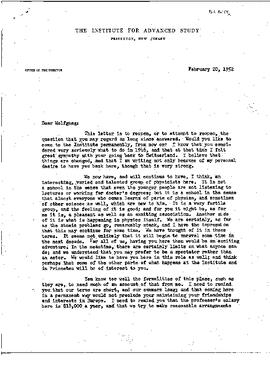
Pauli, WolfgangPauli is sending a selection of journals, but he thinks that Dutch physicist's expectations concerning the content of American and English periodicals for the years 1940 - 1945 are too high. However, some interesting work has been done in the neutral countries and Russia. In the USA some progress has been made in more technical fields, like microwave, radar and heavy cores. Pauli did not contribute to the secret work, but he worked alone on meson theory and quantum electrodynamics. He was not able to solve any real problem in this domain. The most interesting subjects are now Amaldi's experiments on neutron-proton-scattering and its discussion by Hulthèn and Wentel. Pauli will send Casimir and Rosenfeld a copy of his M.I.T. lectures on meson theory, which will soon be available. He says that the problem of the nature of nuclear forces is no more solved than it was in 1940, and he does not expect the secret material to help when it is published. Pauli encloses Onsäger's solution of a two-dimensional Ising model which he considers a masterpiece. Pauli says that he has been offered a professorship at Princeton, but since he is still a professor at Zurich he feels some obligation towards them and plans to postpone his decision until he has visited Zurich. He discusses the post-war situation in Europe and the U.S.A. and says that he feels himself to be a European.
Pauli, WolfgangTells about a report by Schein at a meeting in New York on artificial meson production.
Pauli, WolfgangPauli asks about details of an article by Caldirola on the experimental verification of the relativistic time dilatation.
Pauli, WolfgangPauli refers to an article by Einstein and a talk with him about the epistemological foundation of quantum mechanics. Einstein's belief that there exists an "objective" state of a system without reference to the experimental arrangement is called by Pauli "a philosophical prejudice".
Pauli, Wolfgang