Pauli discusses the timing of his visits to Copenhagen and Leyden.
Pauli, WolfgangLetter
2148 Archival description results for Letter
Pauli wrote "This Radiolecture for the Columbia Centenary has been written and recorded in the summer of 1953. It appeared now in the collection "Man's right to knowledge" Vol. 2.
Pauli, WolfgangPauli would like to make plans for his and his wife's visit in Copenhagen. He is going to participate to a conference in Lund on June 30th.
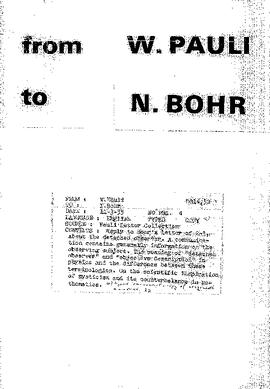
Pauli, WolfgangPauli's reply to Bohr's letter of 2 March. He writes about the meaning of "detached observer" and "objective description" in physics and the difference between these terminologies. He talks about the scientific inspiration of mysticism and its counterbalance in mathematics.
Pauli, WolfgangBohr asks Pauli about his intentions for their relativity meeting in Bern. He writes about a political proposal concerning peace written by Bertrand Russell and sent to many scientists including Pauli and Bohr.
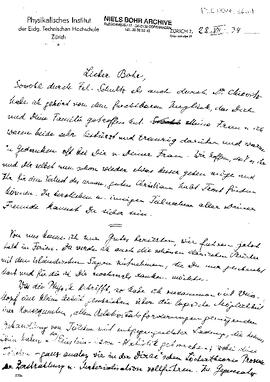
Pauli, WolfgangConcerns the death of Christian Bohr, Niels Bohr's father, and also a paper written with Weisskopf.
Pauli, WolfgangPauli hopes to get Bohr's new manuscript. He talks about the use of half-integer K-values for a description of penetrating electron orbits. He doubts that these methods could lead to a real explanation of the atomic structure.
Pauli, WolfgangPauli writes against Bohr, Kramers and Slater's paper. He mentions his talk with Einstein about the paper and gives Einstein's main arguments against it, in particular his belief in the strict validity of energy-momentum conservation for elementary processes. Pauli gives his own arguments against Bohr's assumption.
Pauli, WolfgangPauli sends Bohr a manuscript of an unpublished work. He writes about his new interest in quantum theory and his idea to explain the anomalous Zeeman-effect through relativistic considerations. His hypothesis is that the doublet-structure of alkali spectra is alone a property of the valency-electron. He talks about the necessity for a correct formulation of the correspondence principle for atoms with more than one electron and about the necessity for a modification of the classical kinematic concept of motion.
Pauli, WolfgangPauli thanks Bohr for the days he spent in Copenhagen.
Pauli, Wolfgang