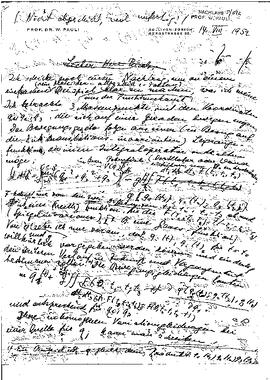
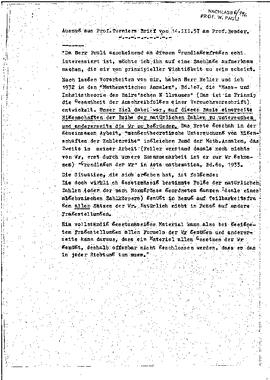
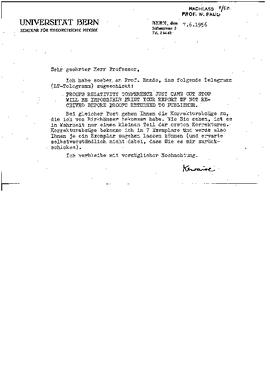
Heckmann explains why he didn't cite Friedman (Z. Phys. 21, 326, 1924) in his work.
Heckmann, OLetter
2148 Archival description results for Letter
Heisenberg writes on the anomalous Zeeman effect.
Heisenberg, WernerHeisenberg writes about Pauli's remarks on a paper by Born and Heisenberg.
Heisenberg, WernerHeisenberg writes on technicalities about a possible meeting between him and Pauli.
Heisenberg, WernerHeisenberg writes about the polarization of spectral lines in electric and magnetic fields according to quantum theory.
Heisenberg, WernerHeisenberg says that in his new mechanics, the geometrical concept of orbit has no sense, as orbits are not observables.
Heisenberg, WernerHeisenberg writes about Bohr's optimism as regards Goudsmit's theory and gives some additional comments on it.
Heisenberg, WernerHeisenberg writes about the connection of the singulet-triplet distance with Pauli's exclusion principle.
Heisenberg, WernerHeisenberg is preparing the manuscript on He. He writes about the problem of the molecule and makes critical remarks about the physical part of Schrödinger's theory. The connection with De Broglie is not yet discovered.
Heisenberg, WernerHeisenberg objects to Pauli's analogy between quantum mechanics on the one hand and quantum electrodynamics and classical Maxwell theory on the other hand. There is not only Maxwell's equations must be quantized, but also the De Broglie Waves. He explains his ideas on the intuitive meaning of quantum mechanics: 1) position of the electron 2) "orbit" of the electron. He agrees with Dirac that their experiments introduce statistics 3) on the "velocity" of the electron. 4)the transition from micro- to macro-mechanics. He writes that every new observation defines a new state. There are a few examples as illustrations.
Heisenberg, Werner