Letter

Elements area

Taxonomie

Code

Bereik aantekeningen

    ron aantekeningen

      Toon aantekening(en)

        Hiërarchische termen

        Letter

          Gelijksoortige termen

          Letter

            Verwante termen

            Letter

              2148 Archivistische beschrijving results for Letter

              2148 results directly related Exclude narrower terms
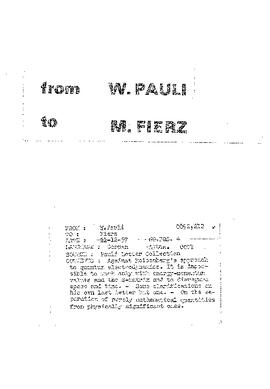
              Letter from Pauli to Fierz
              Letter-2782 · Stuk · 1957/12/11
              Part of Archives of Wolfgang Pauli

              Pauli is against Heisenberg's approach to quantum electrodynamics. It is impossible to work only with energy-momentum values and the S-matrix and to disregard space and time. He talks about some clarifications on his own last letter but one. He writes on the separation of purely mathematical quantities from physically significant ones.

              Zonder titel
              Letter-2794 · Stuk · 1957/12/16
              Part of Archives of Wolfgang Pauli

              Pauli replies to Källén's letter of the 13 December 1957. Pauli agrees with him that the indefinite metric is the correct way. He talks about the macroscopic space-time description with complex roots and the Bisection of zero-states in parts corresponding to the upper and lower half-plane which must be connected with the difference between observed object and observing subject. By this bisection symmetric violations are introduced in a most natural way. He writes on his discussion with Heisenberg and on complex ghosts in weak interactions.

              Zonder titel
              Letter-2805 · Stuk · 1957/12/21
              Part of Archives of Wolfgang Pauli

              Pauli replies to Heisenberg's letter of the 16 December and discusses the formalism and correction of a mistake Pauli made. He writes on group theoretical considerations.

              Zonder titel
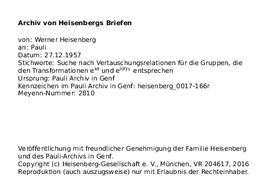
              Letter-2810 · Stuk · 1957/12/27
              Part of Archives of Wolfgang Pauli

              Heisenberg puts a question about the transformations of two continuous groups in his "electrical" theory. If this is solved, the problem of strange particles leptons can be tackled.

              Zonder titel