Pauli writes of a paper by Dürr which contains answers to all questions left open in Heisenberg's letter. He is going to study this paper.
Sin títuloLetter
2148 Descripción archivística resultados para Letter
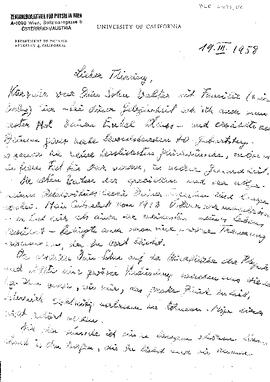
About H. Thirring's 70th birthday, H. Thirring's son, Pauli and H. Thirring's departure from Austria.
Sin títuloPauli replies to Heisenberg's letter of 15 March. He emphasizes the discrepancy of their respective views on symmetry diminuation, spatial boundary conditions and rest mass zero . He specifies their differences of opinion. He writes about the logical possibility that electromagnetism and photons cannot be explained by a spinor model.
Sin títuloThis letter is a reply to Pauli's letter of 17-03-1958. Dürranswers to Pauli's six questions and writes about some corrections he made of his own paper.
Sin títuloHeisenberg replies to Pauli's letters of 19 and 20 March. He suggests a new version of the interpretation of the theory: she is CP-invariant. Therefore the symmetry is not affected in weak interaction. Further possible consequences of this interpretation.
Sin títuloPauli asks some organizational questions in connection with the CERN conference. He writes about Weisskopf's visit to Israel.
Sin títuloPauli writes about his decision not to co-publish with Heisenberg the investigation on the isospin-group. He talks about very strong criticism of the mathematical methods and the physical approach of Heisenberg and his collaborators. He gives suggestions about the possible line of research to be followed.
Sin títuloDürr's reply to pauli's letters of 24 and 26-03-1958 makes some suggestions for the improvement of his calculations.
Sin títuloPauli replies to Källén's letter of the 18 March 1958. He is now sure that the explanation of strange particles having half-integer difference of spin and isospin by means of a degenerate vacuum is wrong. This changes his view on the one-spinor model with "Pauli-invariance", from which only particles with integer difference of spin and isospin can result (i.e. no$\lambda_{o}$-particles).
Sin títuloPauli replies to Wentzel's letter which gives hope that Schafroth, Bardeen, Bogoljubow and Wentzel will find a model of supra-conductivity. He writes about the Max Planck medal.
Sin título