Pauli gives further comments on Bohm's ideas, in particular on the hidden parameters.
Pauli, WolfgangLetter
2148 Archival description results for Letter
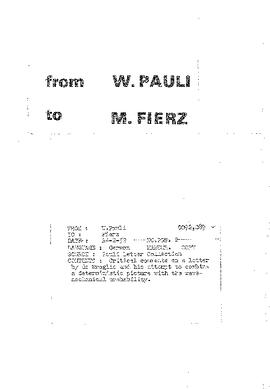
Pauli gives a critical comment on a letter by de Broglie and his attempt to combine a deterministic picture with the wave-mechanical probability,
Pauli, WolfgangPauli gives further analysis of the entropy concept. The entropy of an ensemble is identical with the entropy of a single system. This under the condition that it concerns the measure of the information corresponding to the same ensemble.
Pauli, Wolfgangfierz_0092-106: Pauli writes about the contrast between Kepler and Fludd. He sees both contrary positions in himself. He thinks that there may be a possible relation of his dreams to this. He also makes a connection with problems touched upon in Jung's book "Answer to Job". fierz_0092-107: Pauli offers an essay on the striving for wholeness in physics and the conflict between science and intuitive feeling. He writes on the psycho-physical problem and on science and Neoplatonism. He adds to this some special references to Pauli's book on Kepler.
Pauli, WolfgangPauli writes again about a paper by Pauis. He writes on an essay by Panofsky on the Renaissance and the relation of art and science.
Pauli, WolfgangPauli writes on pairs of opposites in music and on the origins of $\varepsilon
Pauli, WolfgangPauli writes about a letter by W Scherrer asking for recommendation of a paper of his for publication in the Helvetica physica acta.
Pauli, WolfgangPauli writes that the origins of $\varepsilon
Pauli, WolfgangPauli sends his impressions from the Solvay Congress. He writes that the pioneers of quantum physics have become their own epigones, they lost the feeling of intellectual adventure and acquired the attitude of technicians.
Pauli, WolfgangPauli is preparing for his lecture in Mainz. He has read a book by R Otto on "West-eastern mysticism" (1926), and he writes about its contents. He writes a long excursion on the problem of salvation versus science. He believes cognition and scientific cognition tend to come nearer to each other.
Pauli, Wolfgang