Heisenberg has received Fierz's paper and agrees.
Sin títuloLeipzig, Germany
82 Descripción archivística resultados para Leipzig, Germany
Heisenberg writes about the qualification of some of his results in the last letter. The theory still seems promising.
Sin títuloHeisenberg doubts about the usefulness of the Yukawa-potential for nuclear physics. He talks about the relative abundance of light and heavy particles in explosions.
Sin títuloHeisenberg talks about the classical electron-radius as an upper limit of the universal length. He does not believe in Pauli's remark that the potential between proton and neutron at larger distances can be found from mass-defect measurements. In the "wave-like" region one cannot from the potential at large distances and effects resulting from the failure of quantum mechanics for p~h/ro.
Sin títuloHeisenberg asks Pauli if he would be ready to take over part of the paper to be given at the Solvay congress on elementary particles: 1) "on the general properties of elementary particles", 2) "the special empirical forms of interaction and their consequences", 3) "the limitations of the present theory". He was interested in what Fierz told him about gravitational quanta of spin 2.
Sin títuloHeisenberg replies to Pauli's letter. He does not fully agree with Pauli that the inertia of self-energy of the spin is of the order (M.c)/h, because the absorptions of mesons indicate a much smaller cross-section for scattering by protons such as that of Bhabha-Heitler, and because the additional inertia does not change the nuclear forces. The spin-inertia plays a role only in the case of rapidly changing fields. He agrees with Pauli's remark on electron spin.
Sin títuloHeisenberg has sent copy of his Solvay-report also to Bohr. He writes about his trip to the USA.
Sin títuloDiploma [?] of H. H. Euler, directed by W. Heisenberg. Light in Dirac's theory.
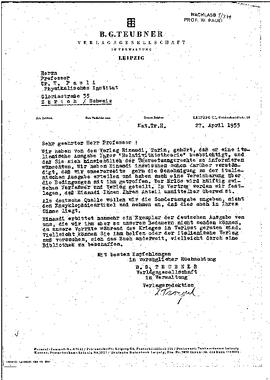
Sin títuloLetter from Teubner Verlagsgesellschaft to W. Pauli. Linked to the publication of "The theory of relativity".
Sin títuloHeisenberg continues his letter on ferromagnetism.
Sin título