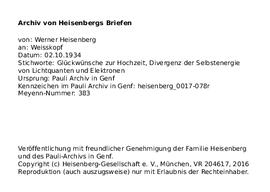
Heisenberg writes on Euler-Kochel's modifications of Maxwell's theory.
Heisenberg, WernerLeipzig, Germany
82 Archival description results for Leipzig, Germany
Heisenberg writes on the treatment of an example according to Neumann's method: the case of an electron in a force field with probably 1/2 for right or left spin. He talks of a application of the result to field theory, of the possibility of representing the state of a system by a matrix depending on a finite number of degrees of freedom, and of some of his doubts about this possibility.
Heisenberg, WernerHeisenberg comments on Neumann's manuscript. He is convinced that the correct quantum wave theory will only be found after the introduction of a universal length. He corrects his statement in the last letter about the state described by the Thomas-Fermi method.
Heisenberg, WernerHeisenberg writes about the consequences of a Delta-interaction in the case of a finite number of particles. This interaction exists only for point-energy show that the "shape" of the electron in quantum electrodynamics is represented by the properties of the density matrix. He writes on a possible semi-classical interpretation of Fermi's theory. He writes about the idea of the Americans that forces between all heavy particles are equal, and some consequences of it. On Euler's application of the Hertree-method to heavy nuclei and the resulting improvement of results.
Heisenberg, WernerHeisenberg talks of results of calculations about their model: lack of relativistic invariance. He gives suggestion for a new model, defined by another Lagrange-function and some comments on the recent ideas about nuclear forces.
Heisenberg, WernerHeisenberg comments on Bloch-Nordsieck's paper. It would be worthwhile to calculate the end of the spectrum. From papers by Anderson, Neddermayer and Blackett it seems to follow that particles exist with masses intermediate between electron and proton, and this is a plausible result. On Cosmic radiation, he says that very great showerscannot be explained by the Bhabha-Heitler formula alone.
Heisenberg, WernerHeisenberg writes about Weisskopf's calculations regarding self-energy.
Heisenberg, WernerHeisenberg writes about the difficulty with the assumption of a Gaussian distribution for the energy values in his calculations.
Heisenberg, WernerHeisenberg replies to two letters from Pauli about empirical data of nuclear moments. He writes about the rule of Fermi and Segrè. He talks about Pauli's idea of the existence of two kinds of neutrons and on the possible types of nuclear forces, about Ehrenfest's death and about Planck's philosophy of science.
Heisenberg, WernerHeisenberg writes more about the theory of holes and about another method for the elimination of an infinite charge density.
Heisenberg, Werner