Polkinghorne replies to Pauli's remarks about the B-field, with reference to some work by R Shaw. He talks about the paper on $\mu$-decay by Salam.
Zonder titelPauli suggests suspending the discussion until new points of view emerge.
Zonder titelPauli is pleased whith Heisenberg's letter of 24 February and continues the discussion.
Zonder titelPauli writes about Gorter's preprint on 58 co-experiments and about a note by Salam.
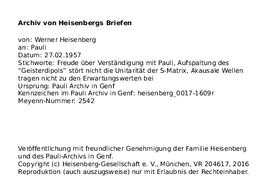
Zonder titelHeisenberg replies to Pauli's arguments about the splitting of the dipole ghost by an interaction energy, and about the problem of causability in connection with his theory.
Zonder titelPauli talks about his plans for a journey to England and Copenhagen. He writes more about parity violation.
Zonder titelPauli asks which of Touschek's papers he could read. He writes about Leiden's paper on Gorter's experiments with orientated 58 co-nuclear spins which are in good agreement with the two-component theory.
Zonder titelPauli replies to Heisenberg's letter of 27 February. He thinks that understanding between him and Heisenberg may be impossible, because he regards Heisenberg's calculations and interpretation as "wishful thinking". There is a discussion of the parity problem.
Zonder titelPauli makes a comment on Fierz's letter. He writes that equations which cannot be derived from a variation principle must fail in the end, both in the mechanics of points and in classical field theory. He speaks about a book by Jordan and he speculates on the origin of life. Pauli suspects that its first beginnings are non-reproductive phenomena like Jung's "synchronic" phenomena.
Zonder titelHeisenberg makes two remarks on Pauli's questions: 1) about complex eigenvalues of the system N+2$\Theta$, 2) about potentials of forces between elementary particles.
Zonder titel