Pauli sends Fierz some critical remarks on an article written by Schrödinger who is not ready to accept the epistemological consequences of quantum mechanics. He also comments on Fierz's statement by an "arbitrary decision of the observer".
Sem títuloEinstein discusses the difference between his and Pauli's view on the significance of the psi-function. If this function does not supply a complete description of the state of a single system, one must look for such a complete description to which the real laws of nature must be related.
Sem títuloThe letter talks about some results of the application of "substraction-quantumelectrodynamics" to a higher approximation of the Compton-effect.
Sem títuloPauli advises van Hove to treat his nucleon problem in a strictly relativistic way. This will change considerably the results concerning the magnetic moment of nucleons.
Sem títuloPauli replies to a letter about affine field theory. Pauli explains why the unity of field theory is impossible, because the reduced curvature tensor splits into a symmetrical and antisymmetrical part, which can never be brought together again.
Sem títuloVan Hove adds a remark to his letter of 9 August, concerning one of the formulae.
Sem títuloPauli has received from Rosental a copy of Bohr's article for "Dialectica" and Bohr's letter. This article will be of great help to him to clarify the contents of other articles in the issue, particularly Bohr's definition of "phenomenon". It would be a great help for the general editorial comment on the whole issue, if Bohr could return to Pauli the proofs of Einstein's article and also drop him a line on his opinion about the remarks which Pauli made himself in his letter to Einstein (of which Bohr has a copy). Every criticism is welcome.
Sem títuloPauli asks Fierz some personal questions regarding the chairs for theoretical physics in Zürich and Basel.
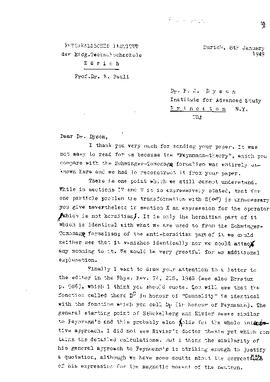
Sem títuloPauli makes some comments on a paper sent by Dyson.
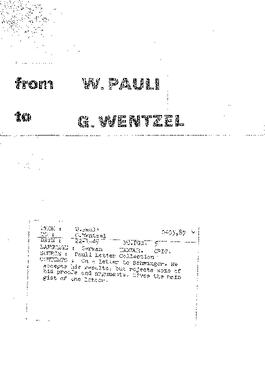
Sem títuloPauli comments on a letter to Schwinger. He accepts his results, but rejects some of his proofs and arguments.
Sem título