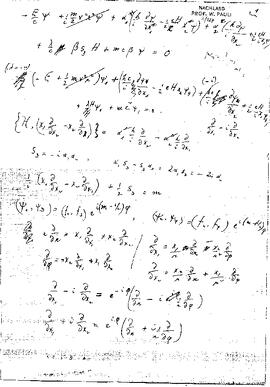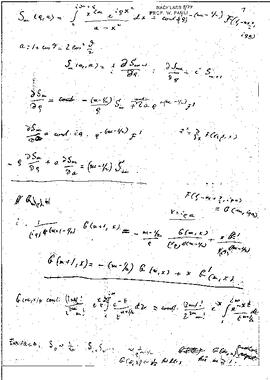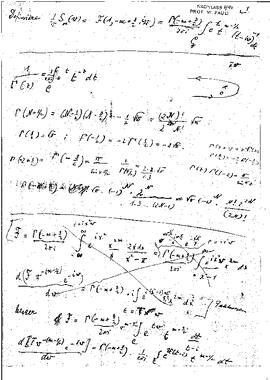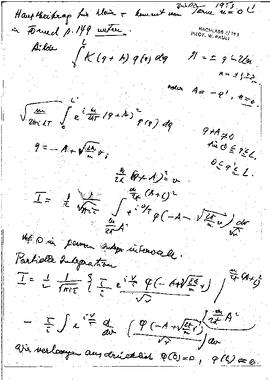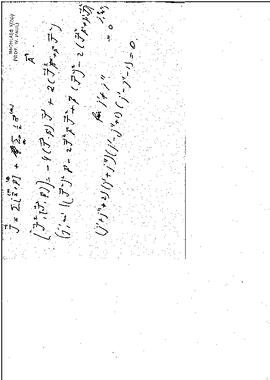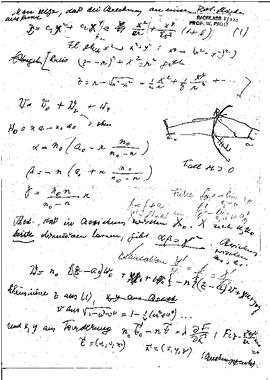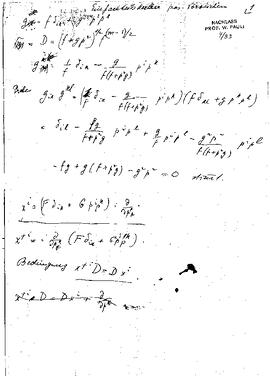
Heisenberg gives detailed calculations to show that their simple method of incorporating the theory of holes into quantum electrodynamics leads to good results.
Sans titreBohr thanks Pauli for his letters with the quick and thoroughgoing answer to his small heart-outpouring. He and Rosenfeld studied Pauli's letters very carefully and agree of course with most of the contents. Bohr thinks that Pauli underestimates the consequence in the correspondence-attack on the atomic problems based on the low value of the fine structure constant.
Sans titrePauli indicates a weakness in Dirac's theory.
Sans titrePauli's last letter was in every respect a cause of great pleasure to Bohr. First of all Bohr and his wife sends Pauli their heartiest congratulations on his approaching wedding and they look forward to having Pauli and his wife on a small visit in their home. The week after Easter would be very suitable, and Bohr hopes that they will feel comfortable in Carlsberg in spite of the columns. Both Rosenfeld and Klein, who is in Copenhagen on a visit, as well as Bohr, were very interested in Pauli's remarks. Bohr will take Pauli's proposals into consideration when the proofs arrive. The unknown author of the first appendix writes that he agrees very much with the contents of Bohr's manuscript and his letters to Pauli. By contrast his view about the problem of the infinite self-energy is somewhat different from what Bohr writes on this subject.
Sans titreHeisenberg writes on the final results of the theory of holes. The whole scheme can be transposed into the quantum theory of waves. He talks about signs of a deeper connection between matter-field and radiation-field.
Sans titreHeisenberg agrees with Pauli's calculations avoiding spin with Bose-statistics. The assumption that a single particle (electron) must be a trivial solution of quantum electrodynamics, should lead to spin with Fermi-statistics. The question is what kind of quantized wave theory will obey the following postulates: the number of particles corresponding to the waves is not necessarily constant, relativistic invariance, a single particle as trivial solution of the equations and energies are always positive.
Sans titreHeisenberg makes some remarks on Pauli's and Weisskopf's theory. The infinite polarization of the vacuum is the result of certain parts of the quantum-theoretical formalism which need corrections.
Sans titrePauli makes an analysis of his own psychological state during recent years. He comment on a book by Buber which Kronig has sent him. He is impressed by Buber's subject-object philosophy and regards the concept as a fundamental one.
Sans titrePauli replies to Born's question about a possible publication in Helv. Phys. Acta. He expresses his interest in some results (spin) of Born's field quantization.
Sans titrePauli writes of his discussion with Weisskopf about Heisenberg's letter to the latter. The result is electrical polarizability of vacuum and self energy are analogous phenomena. The perturbation formalism of substraction-physics can lead to the removal of these phenomena.
Sans titre