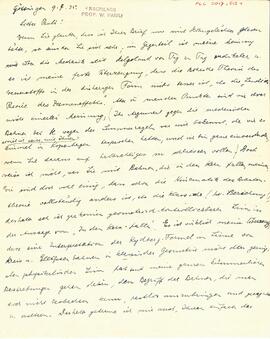
In this reply to a letter from Pauli, Bohr develops his exclusion principle and attempts to explain this rule in the framework of the electronic orbit model.
Sem títuloPauli writes about electron configurations in the elements K to Cu, and about the question of clarification of the hydrogen spectrum and its analogy with a reduced X-ray spectrum.
Sem títuloPauli makes more remarks about the H-atom and its spectrum.
Sem títuloHeisenberg writes about the polarization of spectral lines in electric and magnetic fields according to quantum theory.
Sem títuloHeisenberg says that in his new mechanics, the geometrical concept of orbit has no sense, as orbits are not observables.
Sem títuloPauli's interpretation of intercombination lines and the application of his model to several cases (Zeeman-effect). He expresses hope for the progress of physics through Heisenberg's mechanics.
Sem títuloBohr agrees with almost everything in Pauli's last letter. He reports on a long discussion of Heisenberg's theory and its relation to the earlier quantum theory and on the missing aspects and the future of Heisenberg's theory. His letter has given rise to many changes in Bohr's paper of which he encloses a proof published in: Nature : 116 (1945), 845 and in: Naturwissenschaften : 14 (1926), pp.1.
Sem títuloBohr thanks Bohr for his letter of the 25th September.
Sem títuloHeisenberg writes about Bohr's optimism as regards Goudsmit's theory and gives some additional comments on it.
Sem títuloPauli writes about mathematical contributions to the quantum-mechanical calculus.
Sem título