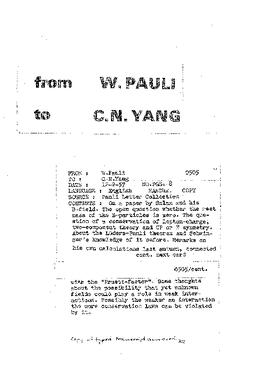
Pauli comments on a paper by Salam and his B-field. He writes about the open question whether the rest mass of the B-particles is zero. He writes about the conservation of lepton charge, two-component theory and CP or T symmetry. He writes about Lüders' and Pauli's theorem, and Schwinger's previous theorem. He makes remarks on his calculations last autumn, connected with the "Pruett-factor".
Pauli, WolfgangPauli writes about his impending trip to the USA. He writes about his work with Heisenberg.
Pauli, WolfgangPauli writes more about the history of the neutrino. He makes critical remarks on Wu's historical paper.
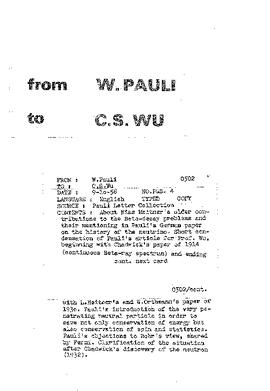
Pauli, WolfgangPauli writes about Miss Meitner's older contributions to the beta-decay problems, mentioned in Pauli's German paper on the neutrino's history. He makes a short condensation of his paper, beginning with Chadwick's paper of 1914 and ending with Meitner's and Orthmann's paper of 1930. Pauli comments on the situation after Chadwick's discovery of the neutron (1932).
Pauli, WolfgangPauli gives his opinion on a candidate for a second chair in theoretical physics in Hamburg.
Pauli, WolfgangPauli thanks Wightman for his letter of the 6th January 1955 which settles all important mathematical questions.
Pauli, WolfgangPauli thanks Wightman and Michel for the study of his paper. He remarks on a priority question regarding Schwinger's paper of 1951. He writes about properties of isotopic spin spaces. He writes about "Schwinger's school" and "Wigner's school".
Pauli, WolfgangPauli comments on a paper by Weyl published in Z. Phys. about quantum physics and group theory.
Pauli, WolfgangPauli agrees with Weyl's incorporation of gravitation in Dirac's theory of the electron, and with his rejection of Fern-parallelisme. He writes about as yet unsolved difficulties of Dirac's theory and two-component theory. He writes about field quantization.
Pauli, WolfgangPauli thanks Weyl for his book on the philosophy of mathematics and natural science. He makes two critical remarks: 1) It is not correct to connect Leibniz with the principle of exclusion. 2) There is no asymmetry of the past-future relation in spontaneous radiation processes, but the concept of spontaneity needs a better definition.
Pauli, Wolfgang