
4072 results with digital objects
Show results with digital objects
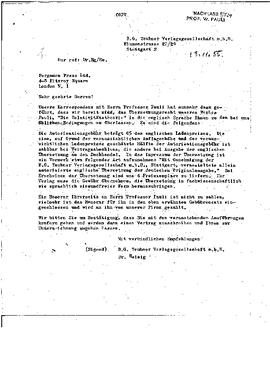
CERN-ARCH-PMC-09-529
·
Item
·
1955/11/18
Part of Archives of Wolfgang Pauli
Letter from Teubner Verlagsgesellschaft (Heisig) to Pergamon Press. Related to the republication of "The theory of relativity".
Teubner Verlagsgesellschaft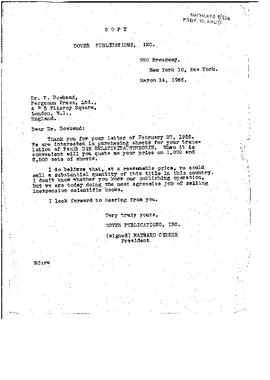
CERN-ARCH-PMC-09-524
·
Item
·
1956/03/14
Part of Archives of Wolfgang Pauli
Letter from Dover Publications (H. Cirker) to Pergamon Press (P. Rosbaud).
Dover Publications Inc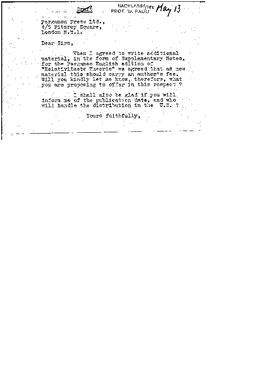
CERN-ARCH-PMC-09-388
·
Item
·
[1957/05/13]
Part of Archives of Wolfgang Pauli
Draft for a letter from W. Pauli to Pergamon Press. Republication of "Theory of Relativtiy".
Pauli, Wolfgang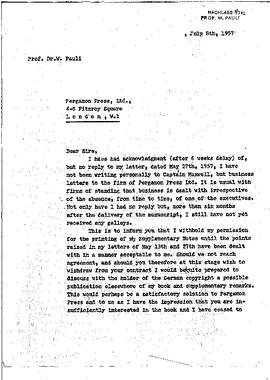
CERN-ARCH-PMC-09-382
·
Item
·
1957/07/08
Part of Archives of Wolfgang Pauli
Letter from W. Pauli to Pergamon Press. Troubles with the republication of "Theory of Relativtiy".
Pauli, Wolfgang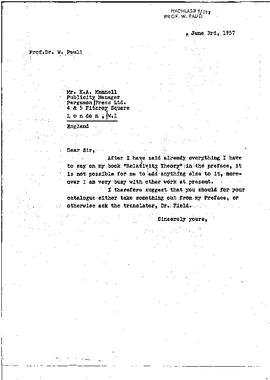
CERN-ARCH-PMC-09-398
·
Item
·
1957/06/03
Part of Archives of Wolfgang Pauli
Letter from W. Pauli to Pergamon Press. Republication of "The theory of relativity". Enclosure: one page of the preface.
Pauli, Wolfgang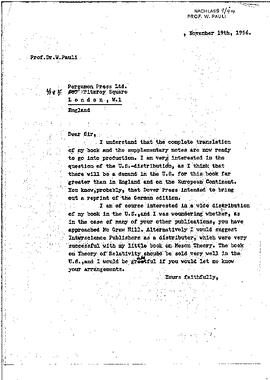
CERN-ARCH-PMC-09-414
·
Item
·
1956/11/19
Part of Archives of Wolfgang Pauli
Letter from W. Pauli to Pergamon Press. Republication of "The theory of relativity".
Pauli, Wolfgang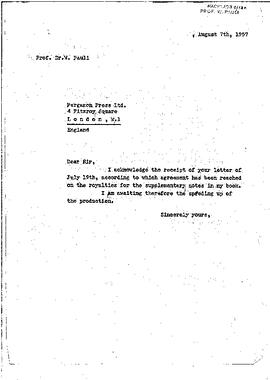
CERN-ARCH-PMC-09-370
·
Item
·
1957/08/07
Part of Archives of Wolfgang Pauli
Letter from W. Pauli to Pergamon Press Ltd. Linked to the publication of "The theory of relativity".
Pauli, Wolfgang