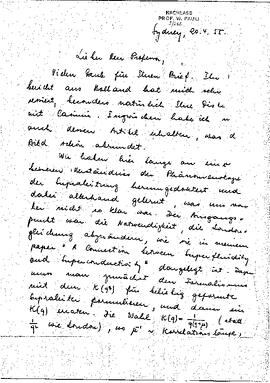
Pauli says that he has written a first version of his Mainz lecture about 'relation metaphysics' (Heilserkenntnis). He discusses some ideas on the subject, citing among others E. A. Burtt's "The Metaphysical Foundations on Modern Science" and B. Russell's "History of Western Philosophy".
Pauli, WolfgangPauli discusses the philosophical duality realism-nominalism. He mentions that he is one of those who think that ideas have a reality at least as strong as that of sensations.
Pauli, WolfgangPauli explains his use of the adjectives "positivistic", "realistic", "idealistic" and "phenomenalistic" as logically linked aspects of the world and as corresponding features of a theory.
Pauli, WolfgangReferring to Bohr's lecture "On the unity of knowledge", Pauli mentions his misunderstandings with Bohr concerning the concept of the "detached observer", the concept of reality in atomic physics, Bohr's conception of "complementarity" as foundation of a world religion, and the use of the concept "antinomic" (antinomisch).
Pauli, WolfgangPauli comments on the "relationship of opposites" such as God and Man.
Pauli, WolfgangPauli outlines his position on Einstein's general theory of relativity and "realistic" ontology.
Pauli, WolfgangPauli questions Kröner's discussion (published in Dialectica 7, 61-69 (1953)) of a book on Einstein (Schilpp P. A. (ed.), "Albert Einstein - Philosopher-scientist", Illinois, 1949). Pauli says that Kröner has understood Einstein's point of view, but not that of a quantum physicist.
Pauli, WolfgangPauli refers to several authors and works concerning biology and physics, including Bohr and his concept of "wholeness", Gagnebin and his understanding of Lamarck as a rationalist, and Goldschmidt's "Different Philosophies of Genetics".
Pauli, WolfgangPauli comments on Van der Waerden's thesis that scientific thinking was originally "down-to-earth" and then developed a connection with mysticism.
Pauli, WolfgangPauli writes about E. A. Burtt's "The Metaphysical Foundations on Modern Science". He criticizes the ascription of "ultimate reality and causal efficacy" to the world of mathematics, and comments on the distinctions science-theology, man-universe, and metaphysics-positivism.
Pauli, Wolfgang