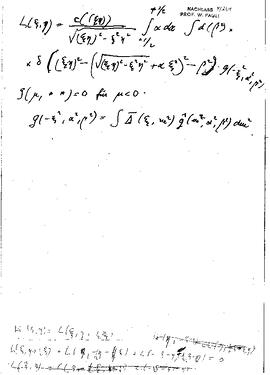
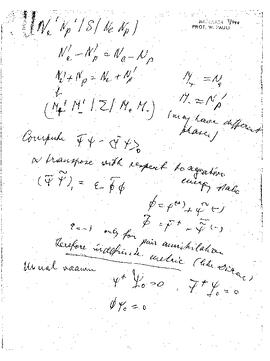
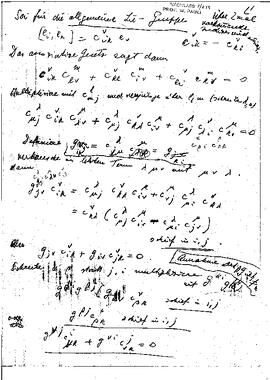
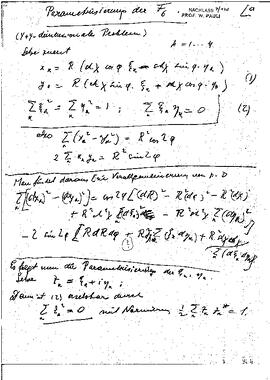
Pauli writes about Jordan's request to send Thellung a lecture by Pauli on problems of the theory of relativity. He writes about Feynman's paper and about Watson's paper.
Sin títuloPauli thanks Delbrück for the copy of his lecture. He hopes that biology will soon have a development analogous to that of physics from 1900 - 1905. He is interested in processes in living organisms which cannot be explained by quantum mechanics. There may exist in living organisms, besides statistical laws, an additional interdependence which might explain biological evolution.
Sin títuloPauli writes about equations by Yang and Mills using a two-component isotopic-spin-space.
Sin títuloPauli refers to an article by Einstein and a talk with him about the epistemological foundation of quantum mechanics. Einstein's belief that there exists an "objective" state of a system without reference to the experimental arrangement is called by Pauli "a philosophical prejudice".
Sin títuloHeisenberg writes about two additions to his last letter, on a certain spinor and on the conditions for the finiteness of certain operators.
Sin títuloPauli sends a few informal lines in answer to Bohr's letter of the 3rd March. Meanwhile he has seen Delbrück and received from him a report about his meeting with Bohr in Copenhagen. He said that Bohr changed his mind on these biological questions soon after he had sent his letter to Pauli. This seems to Pauli quite satisfactory as he is now rather convinced that there is no causal connection between the happenings in a gene and the environment (milieu) of the organism. Now Pauli has spoken with Delbrück and also with other biologists he sees much better where the real problems are. Meanwhile another of their common friends, Otto Stern, passed through New York on his trip from California to Europe. Bohr will soon see him in Copenhagen.
Sin títuloGreen interprets a commutator rule and obtains equations for time-dependent rules.
Sin títuloPauli asks questions regarding Fierz's work on the H-theorem. He writes on the space of Pais and its relation to the space of Kaluza.
Sin títuloPauli writes again about a paper by Pauis. He writes on an essay by Panofsky on the Renaissance and the relation of art and science.
Sin títuloPauli makes several criticisms of Jordan's book.
Sin título