Stern replies to Pauli's letter of the 1st July 1956. He writes about the difference between the diffusion of a gas into a vaccuum and into another gas.
Sem títuloBerkeley, United States
67 Descrição arquivística resultados para Berkeley, United States
Addition to Lüders' letter of 17 June.
Sem títuloSpitzer replies to Pauli's comments on Spitzer's paper "Communication relations of interacting spinor fields".
Sem títuloLüders writes about the point of the $\beta$-disintegration problem, still to be cleared, with reference to calculations by Gatto.
Sem títuloPauli talks about the preliminary report on their joint work. Pauli does not believe anymore in many of the statements in this report. He has written to Heisenberg that the assumption of vacuum degeneration does not seem necessary to him. He writes about his talk with Gürsey in Brookhaven. Pauli expresses his optimism about the solution of the general formal questions, which have nothing to do with group theory. He believes that the symmetry violations do not depend on arbitrary terms in the Hamiltonian but on the metric in Hilbert-space.
Sem títuloPauli writes about the Rochester conference in July. He also writes about dispersion relations and theory of elementary particles.He writes about his work with Heisenberg and about the reaction of other physicists to it. He comments on mirror states in the spinor model and on vacuum degeneracy.
Sem títuloPauli expresses satisfaction over Gürsey's idea to make the neutrino rather than the vacuum responsible for strangeness. He discusses several difficulties connected with the spinor-model.
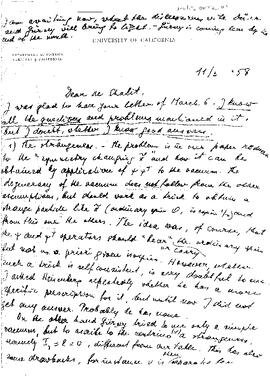
Sem títuloPauli replies to some issues raised in de Shalit's letter of 6 March, including: strangeness; the role of particles with rest mass zero for the decrease in symmetry (group-invariance); the ^-conjugation formalism; and a "philosophical" problem.
Sem títuloPauli says that the spinor model may be wrong, but Källén's considerations do not yet prove this as Pauli undertakes to demonstrate.
Sem título