Pauli writes about the conference in Geneva, saying that the mirror-problem remains unsolved, and that it seems clear that the masses of elementary particles are certain eigenvalues. He is disappointed with the results of Heisenberg's school. He needs help in the mathematics of these eigenvalue problems and wants to hear Källén's opinion on several points. He hopes that Källén's generation will produce constructive models of elementary particles.
Pauli, WolfgangBerkeley, United States
67 Archival description results for Berkeley, United States
Pauli adds an extract from a letter by Weisskopf about the Geneva conference . He has a positive attitude to Schwinger's last paper. He talks about a spinor-model by Gürsey where the neutrino and not the vacuum creates strangeness.
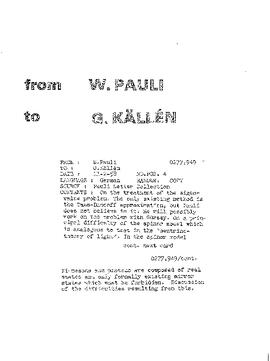
Pauli, WolfgangPauli writes on the treatment of the eigenvalue problem. The only existing method is the Tamm-Dancoff approximation but Pauli does not believe in it. He will possibly work on the problem with Gürsey. He speaks of a principal difficulty of model which is analogous to that in the "neutrino-theory of light". In the spinor model Pi-mesons and photons are composed of real states and only formally existing mirror states which must be forbidden. There is a discussion of the difficulties resulting from this.
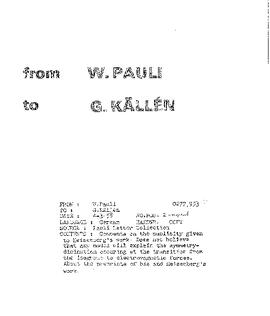
Pauli, WolfgangPauli comments on the publicity given to Heisenberg's work. He does not believe that any model will explain the symmetry diminution occuring at the transition from the isogroup to electromagnetic forces. preprint of his and Heisenberg's work.
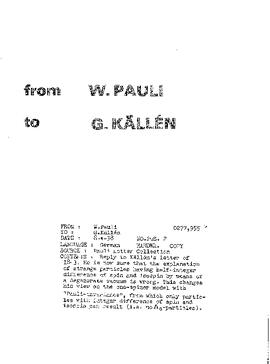
Pauli, WolfgangPauli replies to Källén's letter of the 18 March 1958. He is now sure that the explanation of strange particles having half-integer difference of spin and isospin by means of a degenerate vacuum is wrong. This changes his view on the one-spinor model with "Pauli-invariance", from which only particles with integer difference of spin and isospin can result (i.e. no$\lambda_{o}$-particles).
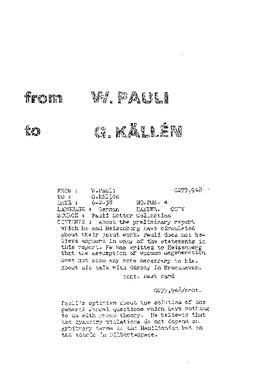
Pauli, WolfgangPauli talks about the preliminary report on their joint work. Pauli does not believe anymore in many of the statements in this report. He has written to Heisenberg that the assumption of vacuum degeneration does not seem necessary to him. He writes about his talk with Gürsey in Brookhaven. Pauli expresses his optimism about the solution of the general formal questions, which have nothing to do with group theory. He believes that the symmetry violations do not depend on arbitrary terms in the Hamiltonian but on the metric in Hilbert-space.
Pauli, WolfgangPauli says that the spinor model may be wrong, but Källén's considerations do not yet prove this as Pauli undertakes to demonstrate.
Pauli, WolfgangPauli writes about his renouncing the partnership with Heisenberg. He thinks there are mistakes in Heisenberg's integration of his equation. Further, if one attempts to loosen either the causality or the unitarity of the metric, this leads to disastrous results in relativistic theories. His impression is that one has to wait for new physical ideas, because mathematical virtuosity alone cannot lead to the discovery of new laws of nature.
Pauli, WolfgangPauli discusses Schwinger's paper "A theory of fundamental interaction" published in Annuals of Physics2, 407, 1957 which treats the mirror problem in an alternative way.
Pauli, WolfgangPauli writes on the mirror problem and the group-invariance problem.
Pauli, Wolfgang